|
Design and fabrication parameters
|
Characteristic
|
Design
|
Fabrication
|
|
wavelength
range
|
No
limit
|
UV∼IR
|
|
zero-order ratio
(zero-order
intensity/incident light intensity)
|
<
10-6
|
<
0.5%
(higher
demand may negotiate)
|
|
the
minimum cell size
|
No
limit
|
0.2um
|
|
phase
order
|
No
limit
|
2∼32
(2nd
order suitable to symmetrical
patterns or off-axis designs)
|
|
cell
number in each unit
|
Up to 15,000 x 15,000
(Higher demand may negotiate)
|
no
limit
|
|
the
maximum tilt angle in patterns
|
>
75 degrees
|
(depending
on the application case)
|
|
DOE
maximum area
|
NA
|
120 x 120mm
seamless for far-field designs
|
|
substrate
|
NA
|
PC,
PET, PMMA, PS, glass、…
|
Unique design technology
The
company has both non-FFT and FFT algorithm design of the DOE. In addition to the general design of the
far, near field, on-axis, and off-axis designs, we also have many excellent
unique features to do the optimized design according to a variety of special
needs.
The following are the
company's unique DOE design capabilities:
|
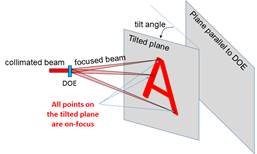
Full focus projected on
an inclined surface (All on focus)
By
a near-field design, general algorithms allow the projected image focused
on a focal plane parallel to the DOE.
Our
algorithm allows the projected image focused on an inclined surface,
obtaining the most clear and complete projection pattern.
|
|
|
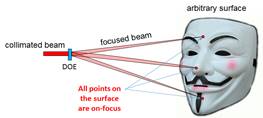
Full focus projected on
an curved surface (All on focus)
By
a near-field design, general algorithms allow the projected image focused on
a flat focal plane.
Our
algorithm allows the projected image focused on an inclined and curved
surface, obtaining the most clear and complete projection pattern on the
surface or a 3D image in space.
|
|
|
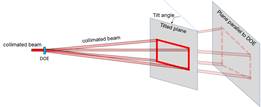
Auto
projection-keystone correction
Oblique
projection produces Keystone aberration. General DOE algorithms can not
correct it. An artificial
pre-distortion compensation method is required.
Our
automatic keystone correction algorithm can correct this oblique projection
aberration and avoid any errors caused by artificial pre-distortion method.
|
|
|
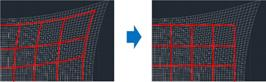
Diffraction distortion
automatic correction
Nonlinear
distortion is produced naturally, the bigger the diffraction angle the
greater the aberration.
The
company′s algorithm can automatically correct the diffraction
aberration, regardless of any pattern design.
|
|
|
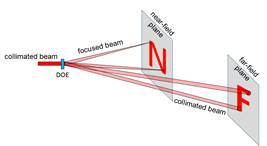
Both near-field and
far-field covered in one design
General
algorithm can design DOEs for near-field and/or far-field applications, but
not both in the same piece of DOE.
However,
our algorithm can design patterns for both near-field and far-field
applications in a single piece of DOE.
|
|
|
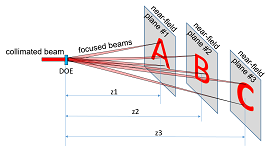
Multiple planes design
at different distances
Whether
near-field or far-field design, a general algorithm is usually for one
focal plane parallel to the surface of the DOE.
Our
algorithm is able to design a DOE which simultaneously projects multiple planar
patterns with different distances and angles to its surface.
|
|
|
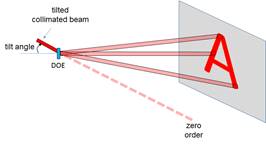
Obliquely incident beam
Usually,
the incident beam is perpendicular to the surface of DOE. Yet our algorithm can make the DOE
accept any incident angle.
Therefore, the optical system design using the DOE can be more
flexible.
|
|
|
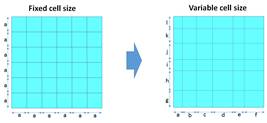
Non-fixed cell size
Generally,
the cell size of DOE design is fixed. Our algorithm can design different
cell sizes in both X and Y directions.
This
particular technique can reduce the periodic noise generated by the
periodic structure, to improve the projection quality of the DOE.
|
|
|


